
Service Detail
Residential Synthetic Grass in Mesquite, TX
Artificial Turf of Mesquite installs residential synthetic grass for homeowners across east Mesquite, Forney, Crandall, Sachse, Sunnyvale, and the surrounding corridor. We serve the full range: new-build lots where natural grass never established, established homes where the lawn has been a losing fight for years, and everything between. Every project starts with an on-site assessment because east Dallas County soil and terrain conditions vary enough that assumptions lead to installations that underperform.
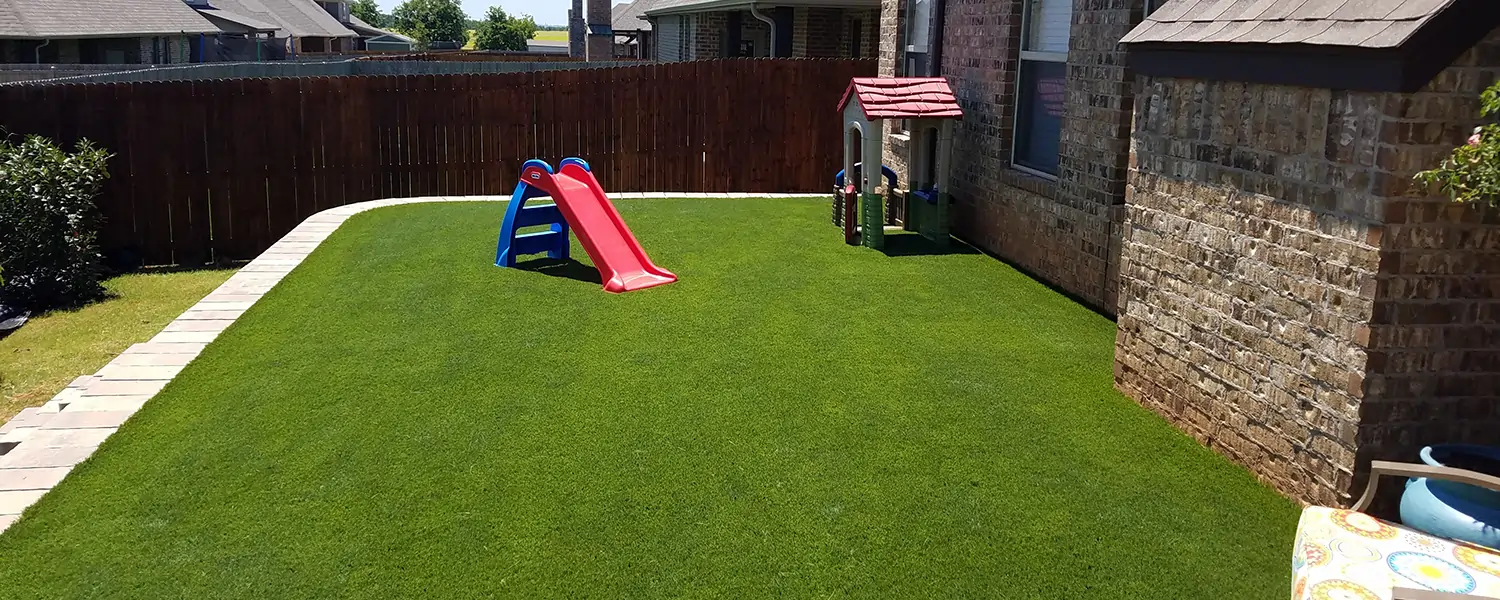
The East Dallas County Residential Lawn Challenge
East Mesquite, Forney, and the surrounding growth corridor present residential lawn conditions that are harder than they look on paper. Builder-grade lots in the newer subdivisions — McKenzie Ranch, Cross Creek, Devonshire, Gateway Parks, Heartland — come with compacted fill soil and thin topsoil that fights natural grass establishment for two to three seasons regardless of irrigation schedule. Established properties in the older east Mesquite neighborhoods deal with clay soil that holds moisture inconsistently, summer heat that pushes irrigation demands beyond what most household systems can sustain, and the shaded zones under established trees where Bermuda grass simply will not grow. Artificial Turf of Mesquite handles both situations with the same approach: on-site assessment, site-specific base specification, and direct installation by our own crew.
- New-build lot installation — from bare soil to finished yard in one to three days
- Established lawn replacement for properties where natural grass has consistently underperformed
- Clay-soil base engineering appropriate for east Dallas County conditions
- Shaded-zone performance that natural grass cannot match
- HOA-compliant product selections for Forney and Sachse corridor communities
- Front yard, backyard, side yard, and specialty area installations
What Residential Synthetic Grass Delivers in This Corridor
- Solves the Builder-Grade Establishment Problem: The single most consistent complaint from new homeowners in east Mesquite's newer phases, Forney's major subdivisions, and the Crandall growth corridor is that natural grass never fully established after move-in. Builders grade and sod to pass occupancy inspection, but the compacted fill under that first sod layer resists root establishment. Within one summer, the sod that looked acceptable at inspection has thinned, browned, or died in patches. Synthetic grass installs on a proper aggregate base regardless of what the builder left behind — it performs from the first week without an establishment period.
- Eliminates the Summer Water Bill Escalation: East Mesquite and Forney corridor homeowners on city water face summer water bills that escalate sharply as irrigation demand peaks in June, July, and August. The tier-rate structures of municipal water systems mean the marginal cost of peak irrigation water is significantly higher than baseline residential use. A standard east-side residential lot running Bermuda grass through August adds $80 to $140 monthly to the summer water bill over what non-irrigation months cost. Synthetic grass eliminates that cost category permanently — from the first summer after installation, the irrigation demand disappears from the bill.
- Shaded-Zone Performance: Established neighborhoods in east Mesquite, Garland's eastern sections, and the older Balch Springs residential areas have mature trees that create partial-shade zones where Bermuda grass cannot establish and St. Augustine struggles with summer heat stress. These shaded zones become the persistent problem areas that require repeated overseeding attempts, targeted fertilization, and still produce thin, patchy results. Synthetic grass performs in partial shade without modification — the fiber does not require photosynthesis, and a properly installed system under a mature tree canopy looks the same as a full-sun installation.
- Usable Yard Regardless of Season or Conditions: Natural grass in east Dallas County has a presentable window of roughly six months before heat stress, winter dormancy, spring overseeding recovery, or late-season drought damage makes the yard look neglected. The remaining six months are managed appearance at best — homeowners who care about exterior presentation spend continuous effort keeping natural grass looking acceptable through conditions that consistently work against it. Synthetic grass is presentable every day of the year without seasonal management. The yard that looked good in April still looks good in August and again in November.
- Reclaimed Weekend Time for Corridor Families: East Mesquite and Forney corridor families are frequently dual-income households with commutes that add 30 to 90 minutes to each workday. The weekend time available for lawn maintenance is limited, and in Texas's growing season, natural grass does not wait for convenient scheduling. Mowing, edging, fertilizing, treating brown patch, repairing irrigation heads, and diagnosing why the corner section is still dying takes two to four hours per week during peak season. That time disappears with synthetic grass — every weekend, from the day of installation forward.
- Long-Term Investment With 15 to 20 Year Horizon: East Dallas County families who install residential synthetic grass are making a decision with a 15 to 20-year forward horizon. The system that goes in today should still be performing when the kids graduate high school. We install products with UV-stabilized fibers tested for Texas sun exposure, back them with base specifications appropriate for the local soil conditions, and use infill systems that maintain performance through the seasonal cycles east Dallas County actually produces — not a national average.
Our Residential Installation Process for East Dallas County Properties
Every residential installation follows a consistent process built around site conditions rather than regional assumptions.
Free On-Site Estimate
We visit the property. We walk every area to be installed, assess drainage, evaluate soil conditions, note root systems and shading, and measure accurately. New-build lots in Forney or east Mesquite need different base assessments than established lawns in older neighborhoods. We do not produce estimates from satellite imagery.
Written Proposal With Site-Specific Specifications
We produce a written proposal that identifies the base depth, product selection, infill type, drainage approach, and total pricing for the specific property. The base specification reflects what we found on site — not a standard depth applied regardless of conditions. HOA product requirements for Forney, Sachse, and Woodbridge communities are addressed in the proposal if applicable.
Vegetation and Soil Removal
Existing sod, vegetation, and soil are removed to the required excavation depth. On new-build lots, this may involve minimal removal if the site is already bare-graded. On established properties, we remove existing turf and correct any drainage issues identified in the assessment.
Aggregate Base Installation and Compaction
Crushed aggregate base is installed and compacted in lifts. The compaction process is not a single pass — it is the step that determines drainage performance for the system's entire lifespan, and we do not rush it. East Dallas County clay-soil properties require thorough compaction to prevent base migration under the seasonal expansion and contraction cycle the soil produces.
Weed Barrier, Turf Layout, and Seaming
Weed barrier is installed over the compacted base. Turf rolls are laid out and positioned for grain direction consistency. Seams are joined and positioned in lower-visibility locations. Edge material is staked at all perimeters with attention to clean, even edge work that holds over time.
Infill Application and Final Grooming
Infill — silica sand, crumb rubber, or antimicrobial infill for pet-zone applications — is applied to specification depth. Power grooming lifts fibers to upright position. Cleanup and debris removal are included.
Residential Synthetic Grass Products
- Polyethylene fibers in multiple pile heights — 1.25 to 2.25 inch depending on application
- Face-weight options from 40 oz standard residential to 60+ oz high-traffic residential
- UV-inhibitor content tested for Texas sun-exposure duration
- Perforated backing with drainage rates appropriate for clay-soil installations
- Multiple blade shapes including W-shape, C-shape, and diamond profiles
- HOA-compliant color and texture selections for corridor communities
- Cooling-technology backing options for direct-sun east Texas applications
- Antimicrobial infill available for pet-zone sections
Residential Synthetic Grass Questions from East Dallas County Homeowners
We moved into a new Forney home and the sod is already failing. What are our options?
This is one of the most common situations we handle in the Forney corridor. Builder-grade sod on compacted fill soil has a high failure rate in east Dallas County conditions — the root system cannot penetrate the fill layer effectively, and the first summer heat cycle exposes the weakness. Synthetic grass installation on a proper aggregate base gives you a permanent alternative that performs immediately without another season of establishment attempts. We assess the specific lot conditions, address any drainage issues the builder created, and install a system that works from the first week.
Our backyard has mature trees that shade most of the lawn. Natural grass has always died there. Can synthetic grass handle shade?
Yes. Synthetic grass has no photosynthesis requirement — it performs identically in partial or full shade as it does in full sun. The only shade-specific consideration is that tree roots may run shallow in the installation zone, which affects base excavation approach. We assess root conditions during the on-site estimate and plan the excavation to work with the root system rather than through it. The finished installation will look the same under the tree canopy as in your open sunny areas.
Will my HOA in Devonshire, Woodbridge, or Gateway Parks approve synthetic grass?
Most HOAs in the Forney corridor, Sachse's Woodbridge community, and similar east Dallas County HOA environments have approval pathways for synthetic grass in both front and rear yards. The approval process typically involves a product specification submittal and sometimes a sample review. We have navigated these processes on prior installations in corridor communities and can advise on which product selections typically satisfy approval criteria and what documentation the process requires.
How much does east Mesquite or Forney residential installation actually cost?
Residential synthetic grass in this corridor typically runs $8 to $15 per square foot installed, depending on base depth requirements, product selection, and site conditions. Properties with heavy clay, significant drainage issues, or large trees requiring careful excavation may run toward the higher end. Properties on fresh-graded lots with minimal site preparation needs may come in toward the lower range. We provide written proposals after the on-site estimate — the only way to give you an accurate number for your specific property.
How long does the average east Mesquite or Forney residential installation take?
Most standard residential lots in the east Mesquite and Forney corridor complete in one to two days. Larger properties or projects with significant drainage correction work may extend to three days. We do not spread standard residential projects across multiple weeks. You have your yard back within two to three days of installation start.
What maintenance does residential synthetic grass actually require?
The maintenance requirement is genuinely minimal: occasional rinsing to clear dust and surface debris, periodic power brooming to restore fiber height in high-traffic zones, and prompt removal of organic debris like leaves from fall deciduous trees. No mowing. No irrigation. No fertilization. No seasonal treatments. For pet-zone sections with antimicrobial infill, we recommend rinsing the pet area weekly and scheduling professional cleaning once or twice annually to manage bacterial load.
Related Services
Artificial Turf Installation
Professional Artificial Turf Installation in Mesquite, TX.
Artificial Turf Maintenance
Professional Artificial Turf Maintenance in Mesquite, TX.
Synthetic Grass Cleaning
Professional Synthetic Grass Cleaning in Mesquite, TX.
Pet Friendly Artificial Turf
Professional Pet Friendly Artificial Turf in Mesquite, TX.
Done Fighting the Lawn? Start With a Free On-Site Estimate.
Artificial Turf of Mesquite provides free on-site estimates for residential synthetic grass projects throughout east Mesquite, Forney, and the surrounding east Dallas County corridor. Call or submit a request — we respond same business day.