
Service Detail
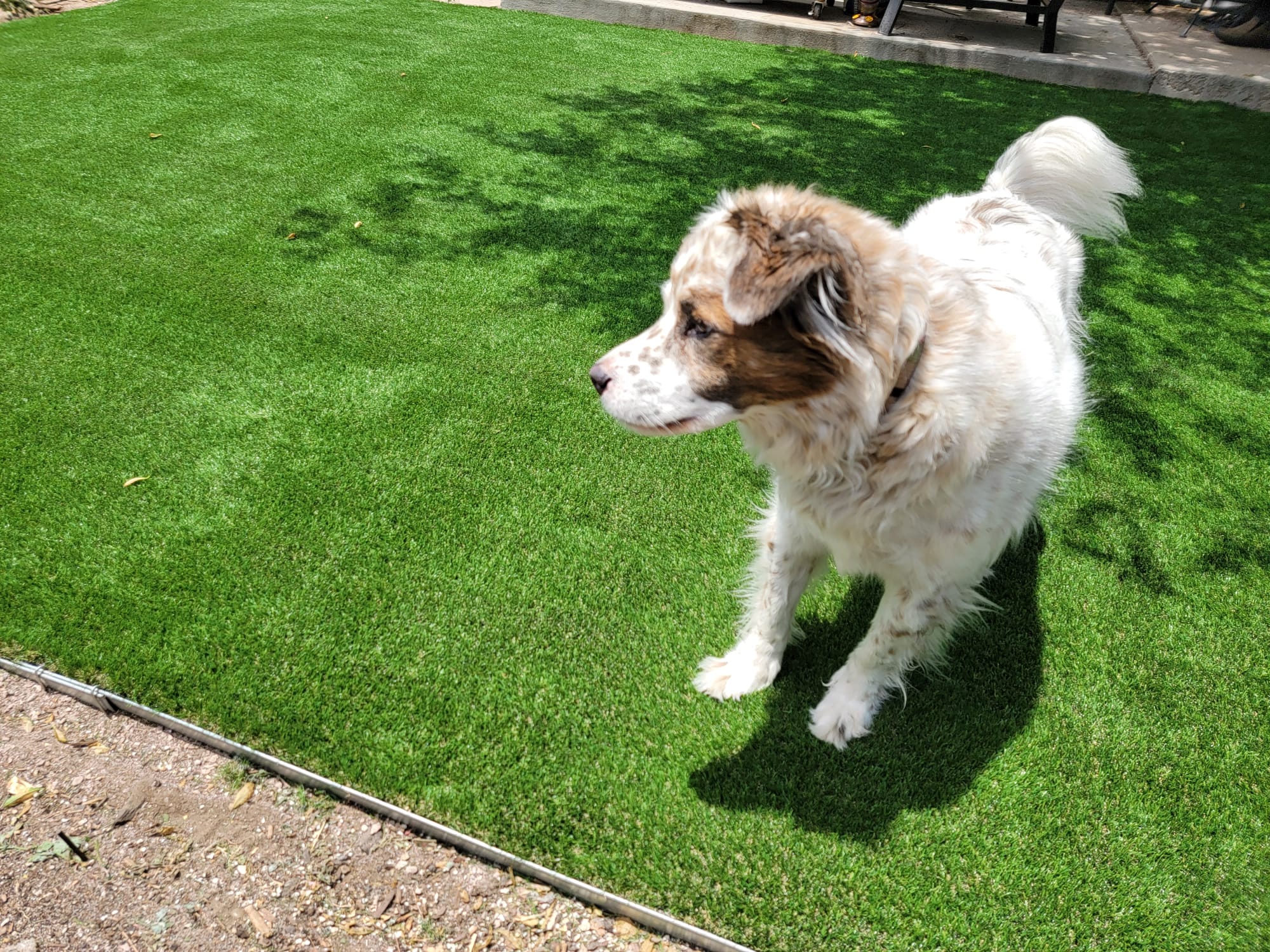
Pet Friendly Artificial Turf in Mesquite, TX
Artificial Turf of Mesquite installs pet turf systems built for east Dallas County conditions — clay-soil drainage, summer heat, and the daily use patterns of family households in Town East, Forney, Sachse, and surrounding communities. Antimicrobial infill, drainage-first base design, and a surface that holds up to real dog use without losing performance.
Why Pet Turf in This Corridor Needs Drainage-First Engineering
East Mesquite, Forney, and the surrounding east Dallas County corridor have a specific pet turf challenge that mild-climate installations do not face: clay-heavy soil that drains slowly, summer temperatures that accelerate bacterial growth in wet infill, and active family use patterns that combine dog traffic with kids, outdoor entertaining, and everything else. A pet turf system that handles these conditions correctly starts with drainage engineering, not surface selection. Artificial Turf of Mesquite designs every pet installation around the soil conditions we actually find on site — because a pet turf system that pools water or traps bacterial load in the infill is a problem that gets worse, not better, over time.
- Base engineered specifically for clay-soil drainage in east Dallas County
- Antimicrobial infill that handles bacterial load in Texas summer heat
- Eliminates mud tracking from pet zones that clay soil produces after rain
- No urine brown spots — ever — regardless of dog traffic volume
- Drainage performance verified at installation, not assumed from spec sheets
- Safe for all dogs from the first day of installation
What Pet Turf Actually Delivers in East Mesquite and Forney Corridor Yards
- Clay-Soil Drainage That Works: The single most important factor in east Dallas County pet turf performance is base drainage. Clay soil in the Town East corridor, Forney subdivisions, and surrounding communities holds water. A pet turf system with an inadequate base will pool after rain and after cleaning — creating exactly the conditions that produce odor and bacterial accumulation. Our base systems for pet installations use additional aggregate depth and perforated backing matched to east Dallas County soil conditions, because proper drainage is what separates a performing pet zone from a persistent odor problem.
- Bacterial Load Management in Summer Heat: East Mesquite and Forney corridor summers push temperatures that accelerate bacterial growth significantly faster than in cooler climates. Pet waste residue that produces minimal odor in spring becomes a noticeable problem by July without antimicrobial infill that actively suppresses bacterial populations. We install antimicrobial infill systems in all pet turf projects — not as an optional upgrade but as a standard component, because the east Texas summer heat cycle makes it necessary for long-term odor control.
- No Mud Tracking After Rain: One of the most immediate quality-of-life improvements east Mesquite and Forney homeowners report after installing pet turf is the elimination of mud tracking. Clay soil in this corridor becomes adhesive after rain events — dogs that go outside during or after a storm come back in with paws coated in the kind of mud that takes serious effort to clean off tile and hardwood. Synthetic turf with a properly compacted aggregate base eliminates this entirely. The surface stays firm and clean-pawed through rain events that would turn a clay yard into a mudfield.
- Consistent Surface for Dogs with Joint or Age Issues: Older dogs and dogs with joint conditions benefit from the consistent, cushioned surface that synthetic turf provides. Natural grass on east Dallas County clay soil develops hard-packed bare zones, root bumps, and drainage ruts that create uneven footing. A properly installed synthetic turf system on a compacted aggregate base provides a level, consistent surface that does not develop the hard-pan and bare-patch patterns that natural grass under dog traffic creates.
- Eliminates the Perpetual Resodding Cycle: Dog-traffic zones on natural grass in east Mesquite and Forney corridor yards typically require resodding or overseeding every one to two years. The combination of concentrated use, clay soil compaction, urine nitrogen content, and summer heat stress destroys natural grass in pet areas faster than in the rest of the yard. Pet turf installed once on a proper base provides a 15 to 20-year surface that does not require periodic replacement — ending the cycle of repeated sod cost and establishment struggle.
- Usable from Day One for Multiple Pets: Multi-dog households in east Mesquite, Forney, and Sachse are among the most consistent pet turf buyers we work with, because the math on natural grass under two or three dogs in this climate is particularly unfavorable. Pet turf handles multiple-dog use without the degradation curves that natural grass produces — the surface does not develop preferential paths or compaction zones the way soil does, because the aggregate base distributes load across the full area rather than concentrating it at dog traffic routes.
How We Install Pet Turf in East Dallas County Yards
Pet turf installations follow a process designed around drainage performance first — because everything else depends on it.
Free On-Site Pet Zone Assessment
We visit the property and walk the pet zones specifically — identifying existing drainage patterns, soil conditions, slope and grade, and any problem areas from existing use. We also discuss how the yard is used: number of dogs, size and activity level, whether the zone connects to indoor access points, and what the homeowner's primary pain points are with the current setup.
Base and Drainage Specification
Based on the site assessment, we specify the base depth, aggregate type, and backing perforation density required for proper drainage in that specific location. East Mesquite and Forney corridor properties with heavy clay often require deeper aggregate than regional averages suggest. We do not apply a single standard — we match the base to what the site actually needs.
Existing Vegetation and Soil Removal
We remove existing grass, vegetation, and soil to the specified excavation depth. For properties with existing mud problems or root systems from damaged natural grass, we clear and address those conditions before laying base material.
Aggregate Base Compaction
Crushed aggregate base is installed and compacted in lifts to the specified depth. Compaction quality determines drainage performance for the system's entire lifespan. We do not rush this step — a properly compacted base is the foundation of a pet turf system that works in year 10 the same way it did in year one.
Weed Barrier and Turf Installation
Weed barrier is installed over the compacted base. Pet-grade turf with hole-punched backing is laid, positioned with grain direction consistency, and cut to fit the installation area.
Seaming, Staking, and Perimeter Finish
Seams are joined and all perimeters are staked. Edge work in pet zones is finished tightly to prevent edge-lifting that dogs can catch with paws or noses — a detail we pay specific attention to on pet installations.
Pet Turf System Components
- Hole-punched backing with drainage rates tested for clay-soil conditions
- Antimicrobial infill — standard on all pet installations, not an optional upgrade
- Polyethylene fiber in pet-appropriate pile heights (1.25 to 1.75 inch typical)
- Face-weight and density matched to expected dog traffic volume
- UV-stabilized fibers with documented Texas sun-exposure performance
- Perimeter edge finishing with pet-proof stake density
- Cooler-backing options for summer heat management in direct-sun zones
Pet Turf Questions from the Corridor
How do pet odors actually get eliminated, not just masked?
Odor in synthetic pet turf is driven by bacterial accumulation in the infill and backing — not surface residue. Rinsing moves waste but leaves the bacterial population that causes persistent odor. Antimicrobial infill suppresses bacterial growth at the source. In east Mesquite and Forney corridor heat, this is not optional — summer temperatures accelerate bacterial growth significantly compared to cooler climates, and systems without antimicrobial infill develop odor within one or two summer cycles.
We have two large dogs that dig. Will they destroy the turf?
Properly installed synthetic turf with a compacted aggregate base is significantly more resistant to dog digging than natural grass. The aggregate base does not yield the way soil does — dogs that dig in natural grass are rewarded by moving soil, while the resistance of compacted aggregate discourages persistence. Edge staking with appropriate density prevents perimeter lifting. Some determined dogs will test edges; we install with extra stake density on pet projects specifically for this.
Does the surface get too hot for dogs in east Mesquite summers?
Direct-afternoon-sun synthetic turf in Texas does absorb heat. For pet zones in full-sun positions, we recommend periodic light rinsing during peak afternoon heat — ten minutes of water immediately cools the surface. We also offer backing products with cooling technology that reduce surface temperature compared to standard backing. Most dogs self-regulate and avoid direct sun during peak heat; shaded access to the turf zone is recommended for extended outdoor time in July and August.
Can I install pet turf adjacent to natural grass areas?
Yes. We transition edges cleanly between synthetic and natural grass areas. The transition is finished with edging material that keeps the two surfaces separate without creating a trip hazard or an edge that dogs can catch.
Will my Forney or Sachse HOA approve pet turf?
Most HOAs in the Forney corridor, Sachse's Woodbridge community, and similar east Dallas County HOA environments have approval pathways for synthetic turf in rear yard applications. Pet turf in backyard zones typically encounters fewer HOA restrictions than front yard installations. We have navigated these processes on prior corridor projects and can advise on documentation and product selections that align with typical approval criteria.
How long does pet turf last with active dog use?
A properly installed pet turf system with antimicrobial infill in east Dallas County should perform for 15 to 20 years under normal residential dog use. High-volume use — three or more large dogs using the zone heavily — may reduce the upper range, but the base and infill system we install is designed for heavy residential pet use rather than light or intermittent applications.
Related Services
Artificial Turf Installation
Professional Artificial Turf Installation in Mesquite, TX.
Artificial Turf Maintenance
Professional Artificial Turf Maintenance in Mesquite, TX.
Synthetic Grass Cleaning
Professional Synthetic Grass Cleaning in Mesquite, TX.
Putting Green Installation
Professional Putting Green Installation in Mesquite, TX.
Ready to Stop Fighting the Mud and Odor Cycle?
Artificial Turf of Mesquite provides free on-site estimates for pet turf installations throughout east Mesquite, Forney, and the surrounding corridor. We assess drainage before we propose — because that is what determines whether a pet turf system actually works in east Dallas County conditions.