Service Detail
Artificial Turf Repair in Mesquite, TX
Artificial Turf of Mesquite provides repair services for synthetic turf systems throughout east Mesquite, Forney, Crandall, Sachse, and the surrounding corridor. Seam separation, edge lift, drainage failure, infill displacement, and base settlement are all repairable — and in most cases, addressing them promptly costs significantly less than waiting until the condition requires section replacement.
What East Dallas County Conditions Do to Synthetic Turf Over Time
Synthetic turf systems in the east Dallas County corridor operate through conditions that are harder on installations than national product specifications assume. Clay soil expands and contracts with moisture changes more significantly than sandy or loam soils, putting stress on seams and edge stakes over time. Summer heat cycles in east Mesquite and the Forney corridor push UV exposure and surface temperature loads at the upper range of product ratings. And the clay-particle dust environment that east Texas produces accumulates in backing and infill, gradually reducing drainage performance. These conditions produce repair needs that are predictable and addressable — but that require someone familiar with the local environment to diagnose correctly. Artificial Turf of Mesquite repairs systems we installed and systems installed by others.
- Seam repair for separations caused by clay-soil ground movement
- Edge staking for lift from expansion-contraction cycles in east Dallas County soil
- Drainage restoration for systems with clay-particle infill accumulation
- Infill replenishment for displaced or compacted infill sections
- Base correction for settled areas that have developed drainage problems
- Emergency repair for systems with tripping hazard or safety issues
Why Timely Repair Matters in the East Dallas County Environment
- Seam Separation Worsens Progressively in Clay-Soil Ground: East Dallas County clay soil expands when wet and contracts as it dries. This seasonal movement puts lateral stress on turf seams from below. A seam that has opened a quarter inch can be rejoined cleanly and invisibly. The same seam after two more wet-dry cycles may have opened enough that the repair requires material overlap and section replacement to achieve a clean finish. The cost difference between a seam caught early and one caught late is significant. We provide repair assessments that tell you honestly what the current condition is and what the trajectory looks like if it is left unaddressed.
- Drainage Failure Gets Worse Without Intervention: Clay-particle accumulation in synthetic turf backing and infill is a gradual process. Early-stage drainage slowdown — the system is draining, but not at the rate it was designed for — is addressable through professional cleaning and infill treatment. If accumulation continues to the point where drainage capacity drops below the rainfall rate the system regularly encounters, surface pooling begins after every rain event. The repair approach at that stage may require infill removal, base cleaning, and infill replacement — a more substantial intervention than what early treatment requires.
- Edge Lift Creates Safety Hazards: Lifted turf edges from stake pull-out under clay-soil movement create trip hazards that are real safety liabilities on residential and commercial properties. A raised edge that is repaired promptly with appropriate re-staking and edge compound requires thirty minutes of work. A raised edge that catches a foot, tears further, and becomes a safety complaint on a commercial property is a different situation. We prioritize repair assessments for safety-flagged conditions.
- We Repair Systems We Did Not Install: Artificial Turf of Mesquite repairs synthetic turf systems installed by any contractor. We do not require that we performed the original installation. Our repair assessments identify the root cause of the failure — whether it is a product issue, installation specification error, or normal wear under east Dallas County conditions — and address it at the source rather than applying a surface patch that leaves the underlying problem to recur.
- Base Settlement Repair Before It Becomes Replacement: Base settlement under east Dallas County clay soil can develop in areas where initial compaction was insufficient or where soil conditions were inconsistent across the installation area. Settled base shows up as surface depressions where water pools and where the turf surface has lost its original profile. Early-stage settlement can often be addressed by targeted base injection or localized turf removal and base correction without requiring full section replacement.
- Infill Replenishment Extends System Lifespan: Infill displacement is a normal occurrence on residential turf systems with heavy family use. Infill migrates toward perimeters, accumulates around drainage paths, and compacts in high-traffic zones — all of which reduce the cushioning and fiber support that infill provides. Replenishing infill before the system reaches critically low levels extends fiber lifespan and prevents the matted appearance that low-infill systems develop. Infill replenishment as part of a repair or maintenance visit is significantly cheaper than addressing the consequences of prolonged low-infill operation.
How We Handle Turf Repair in the East Dallas County Corridor
Repair starts with diagnosis, not with a standard scope applied regardless of what caused the problem.
On-Site Repair Assessment
We visit the property and assess the reported issue as well as the overall system condition. Seam and edge problems are often symptoms of underlying base or drainage conditions that need to be addressed along with the surface repair. We identify root causes, assess what the current state will look like in six months if left unaddressed, and provide a repair scope that addresses the actual problem.
Written Repair Scope and Estimate
We provide a written repair scope and pricing before any work begins. For safety-hazard conditions — raised edges, seams with tripping potential — we can often mobilize quickly after the assessment to address the safety concern, with full repair to follow on a scheduled basis.
Seam Repair
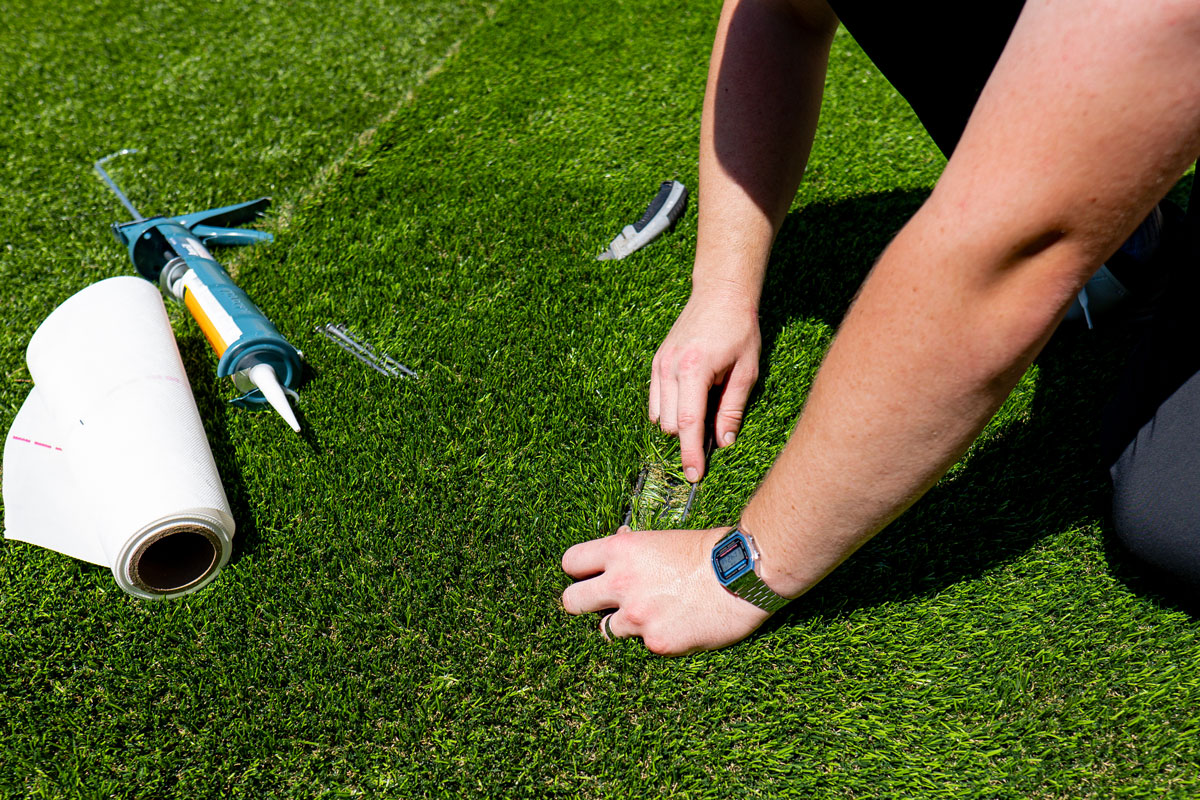
Separated seams are cleaned, re-joined using seam tape and adhesive appropriate for the specific turf backing, and compressed until cured. Properly repaired seams are not visible from standing height. For seams where the separation has caused fiber damage at the edges, we address the fiber condition as part of the seam repair.
Edge Repair and Re-Staking
Lifted edges are re-flattened, additional stakes are installed at appropriate spacing for the soil conditions at that section of the property, and edge compound is applied where needed to secure the perimeter against further lift. For persistent edge-lift situations driven by root intrusion or soil movement, we address the underlying condition before re-staking.
Base Correction
For sections with base settlement or drainage failure driven by base-level issues, we address the base directly. This may involve turf removal, base material addition and compaction, and turf reinstallation over the corrected base. We match product to original installation as closely as possible for color and texture consistency.
Infill Restoration and Drainage Verification
Infill displacement or compaction is corrected by adding infill material matched to the original product type and running water through the system to verify drainage rate. We do not close a repair project without confirming that the drainage performance meets the specification the installation was designed for.
Repair Services Available
- Seam repair and re-seaming for all backing types
- Edge re-staking and perimeter securing
- Base settlement correction and drainage restoration
- Infill replenishment — silica, crumb rubber, and antimicrobial types
- Fiber re-tufting for localized damage from heat, pets, or impact
- Pet damage repair — edge and interior sections
- Emergency repair for safety-hazard conditions
- Drainage restoration cleaning for clay-particle accumulation
- Turf section replacement where repair scope requires it
Repair Questions from East Dallas County Turf Owners
My turf has a seam that is opening up. Can that be repaired without replacing the whole section?
In most cases, yes. Seam separation in east Dallas County turf is one of the most common repair requests we receive — clay soil movement puts stress on seams over time. If the separation is caught before the fiber edges have frayed significantly, the repair is clean and invisible from standing height. If the separation has been open long enough that the fiber edges have damaged, repair may require a material overlay or small section replacement to achieve an acceptable finish. Send us a photo or schedule an assessment — we can give you an honest read on what it requires.
The edges of my turf are lifting in a few spots. Is that a big repair?
Edge lift from stake pull-out is a straightforward repair in most cases — the edge is re-secured with additional stakes and edge compound. The variable is whether the lift is driven by soil movement alone or by a root system intruding under the edge. Roots can displace edge stakes more aggressively than soil movement. We assess the cause during the repair visit and address it at the source rather than re-staking in a way that the same root pressure will undo in another season.
Our turf is draining very slowly since we moved in — it was not installed by you. Can you fix it?
Yes. Drainage slowdown in east Dallas County turf is commonly driven by clay-particle accumulation in backing and infill. We assess the system's current drainage rate and the contamination level, then determine whether the issue is addressable through professional cleaning or requires infill removal and replacement. We repair and service systems installed by any contractor.
Part of our turf has a depression where water pools after rain. What is causing that?
Surface depressions with pooling after rain are typically a base settlement issue — the aggregate base has shifted or settled unevenly, creating a low point in the surface profile. Addressing this requires turf removal in the affected area, base material addition and recompaction to restore the correct grade, and turf reinstallation. The repair eliminates the pooling permanently when the base is corrected correctly. We assess the extent of the settlement and provide a scope specific to the affected area.
Is it worth repairing a turf system that is 10 or 12 years old, or should I just replace it?
It depends on the condition of the fiber, backing, and infill in the unaffected sections of the system. A 10-year-old system with good fiber profile, intact backing, and sound base that has a localized seam or edge problem is often worth repairing — the system has several years of remaining life if the specific failure is addressed. A system where the fiber has UV-degraded throughout, the backing has lost flexibility, or the infill is uniformly depleted may be closer to replacement territory even if the specific reported issue is minor. We give you an honest assessment of both the repair cost and the remaining system life so you can make that decision with complete information.
Can dogs damage synthetic turf badly enough to require repair?
Digging dogs can damage turf edges and occasionally create interior tears if they are persistent on a single spot. Edge sections that dogs have lifted or torn are repairable in most cases. Interior sections damaged by concentrated digging may require material patching. We carry turf products in common colors and textures that produce acceptable color matches on most systems — not identical to the original product, but not visibly mismatched from standing height either.
Related Services
Artificial Turf Installation
Professional Artificial Turf Installation in Mesquite, TX.
Artificial Turf Maintenance
Professional Artificial Turf Maintenance in Mesquite, TX.
Synthetic Grass Cleaning
Professional Synthetic Grass Cleaning in Mesquite, TX.
Pet Friendly Artificial Turf
Professional Pet Friendly Artificial Turf in Mesquite, TX.
Need a Repair Assessment? We Come to You.
Artificial Turf of Mesquite assesses and repairs synthetic turf systems throughout the east Dallas County corridor. Call or submit a request — we schedule repair assessments promptly and can often address safety-hazard conditions the same week.